


Meltdown or Tantrum? Understanding the Difference

Every child communicates their needs, feelings and experiences in different ways.
Sometimes those communications can be loud, emotional and overwhelming, leaving adults wondering: Is this a tantrum, or is it a meltdown?
Many families use the term meltdown to describe an intense reaction to feeling overwhelmed, where emotions and distress become so significant that they temporarily lose the ability to cope with the situation around them.
Although the two can look similar from the outside, they are very different experiences and require very different responses.
Understanding the distinction can help parents, carers and professionals support children more effectively and compassionately.
What Is a Tantrum?
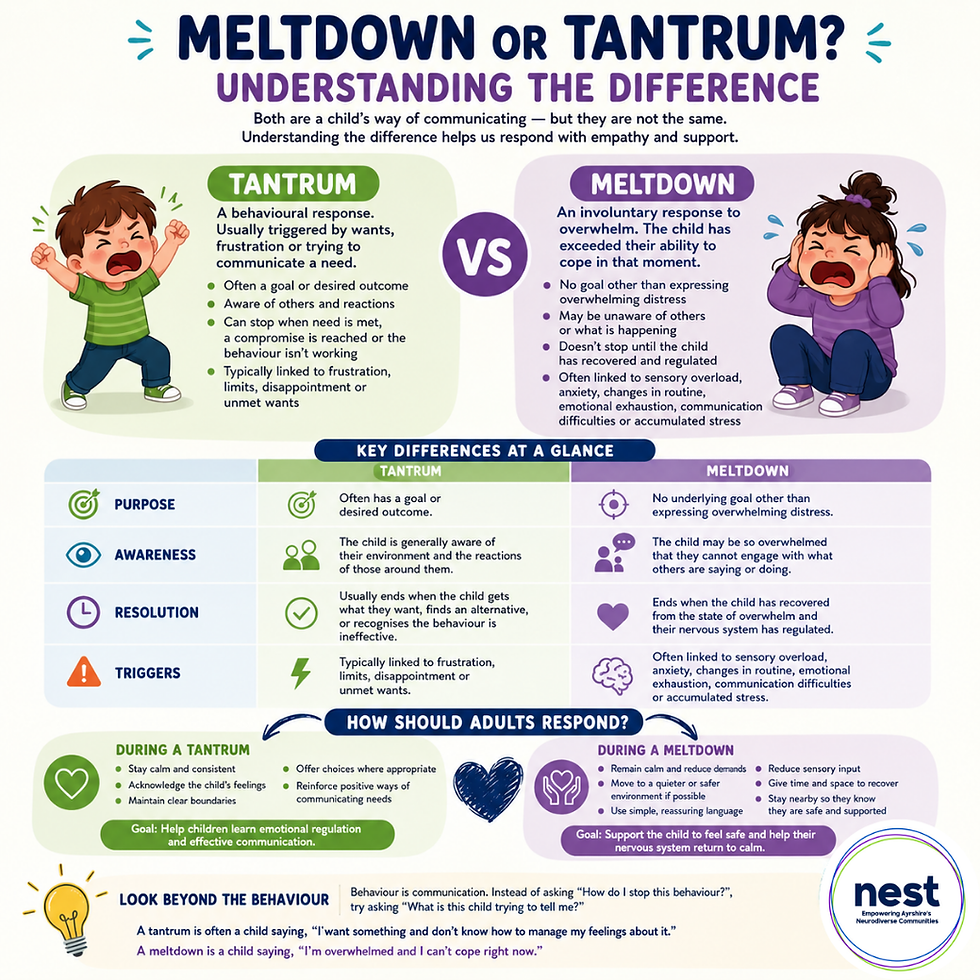
A tantrum is a behavioural response, usually triggered when a child wants something, is frustrated, or is trying to communicate a need.
Tantrums are a normal part of child development and are particularly common in younger children who are still learning how to regulate their emotions.
A child having a tantrum may:
Cry, scream, shout or stomp their feet 😭
Refuse to follow instructions 🙅♂️
Throw objects or slam doors 🚪
Look around to see how others are responding 👀
Stop and restart the behaviour depending on the outcome ⛔
Typically, a tantrum has a purpose. The child may want a toy, more screen time, a different snack, or to avoid an activity they do not want to do. Once the need is met, a compromise is reached, or the child realises the behaviour is not achieving the desired result, the tantrum often decreases or stops.
What Is a "Meltdown"?
A meltdown is not a choice or a behavioural strategy.
It is an involuntary response to overwhelming stress, sensory overload, anxiety, frustration or emotional distress.
During a meltdown, a child has exceeded their capacity to cope with what is happening around them.
Their nervous system is essentially in a state of overwhelm, making it very difficult for them to process information, communicate effectively or regulate their emotions.
A child experiencing a meltdown may:
Cry, scream or yell uncontrollably 😭
Become physically distressed 😠
Cover their ears or eyes 🙈
Attempt to escape the situation 🏃
Shut down or become non-verbal 🤫
Seem unaware of the reactions of others ⚠️
Continue to be distressed even when demands are removed 🔄️
Unlike a tantrum, a meltdown cannot be simply "stopped" by offering a reward, consequence or compromise. The child needs support, safety and time for their nervous system to recover.
Key Differences
Purpose 🎯
Tantrum: Often has a goal or desired outcome.
Meltdown: No underlying goal other than expressing overwhelming distress.
Awareness ⚠️
Tantrum: The child is generally aware of their environment and the reactions of those around them.
Meltdown: The child may be so overwhelmed that they cannot engage with what others are saying or doing.
Resolution ⛔
Tantrum: Usually ends when the child gets what they want, finds an alternative, or recognises the behaviour is ineffective.
Meltdown: Ends when the child has recovered from the state of overwhelm and their nervous system has regulated.
Triggers ‼️
Tantrum: Typically linked to frustration, limits, disappointment or unmet wants.
Meltdown: Often linked to sensory overload, anxiety, changes in routine, emotional exhaustion, communication difficulties or accumulated stress.
How Should Adults Respond?
During a Tantrum
It can be helpful to:
Stay calm and consistent
Acknowledge the child's feelings
Maintain clear boundaries
Offer choices where appropriate
Reinforce positive ways of communicating needs
The goal is to help children learn emotional regulation and effective communication.
During a Meltdown
The priority shifts from teaching to supporting.
Helpful strategies may include:
Remaining calm and reducing demands
Moving to a quieter or safer environment if possible
Using simple, reassuring language
Reducing sensory input such as noise or bright lights
Giving the child time and space to recover
Staying nearby so they know they are safe and supported
Afterwards, when the child is calm, adults can explore what may have triggered the meltdown and consider ways to reduce similar stressors in the future.
Looking Beyond the Behaviour
One of the most important things to remember is that behaviour is communication.
Whether a child is experiencing a tantrum or a meltdown, they are telling us something about their needs, emotions or ability to cope in that moment.
Rather than asking, "How do I stop this behaviour?" it can be more helpful to ask, "What is this child trying to tell me?"
By understanding the difference between tantrums and meltdowns, we can respond with greater empathy, build stronger relationships and create environments where children feel safe, understood and supported.
A tantrum is often a child saying, "I want something and don't know how to manage my feelings about it."
A meltdown is a child saying, "I'm overwhelmed and I can't cope right now."
Recognising this difference allows us to move from simply managing behaviour to truly meeting children's needs - a key step in fostering emotional wellbeing and helping every child thrive.


Comments