


Why Consequences Don't Always Change Behaviour

For generations, consequences have been a common approach to managing behaviour.
Whether at home, in school, or in the workplace, many people believe that if an individual experiences a consequence for a behaviour, they will be less likely to repeat it in the future.
But what happens when the behaviour continues despite repeated consequences?
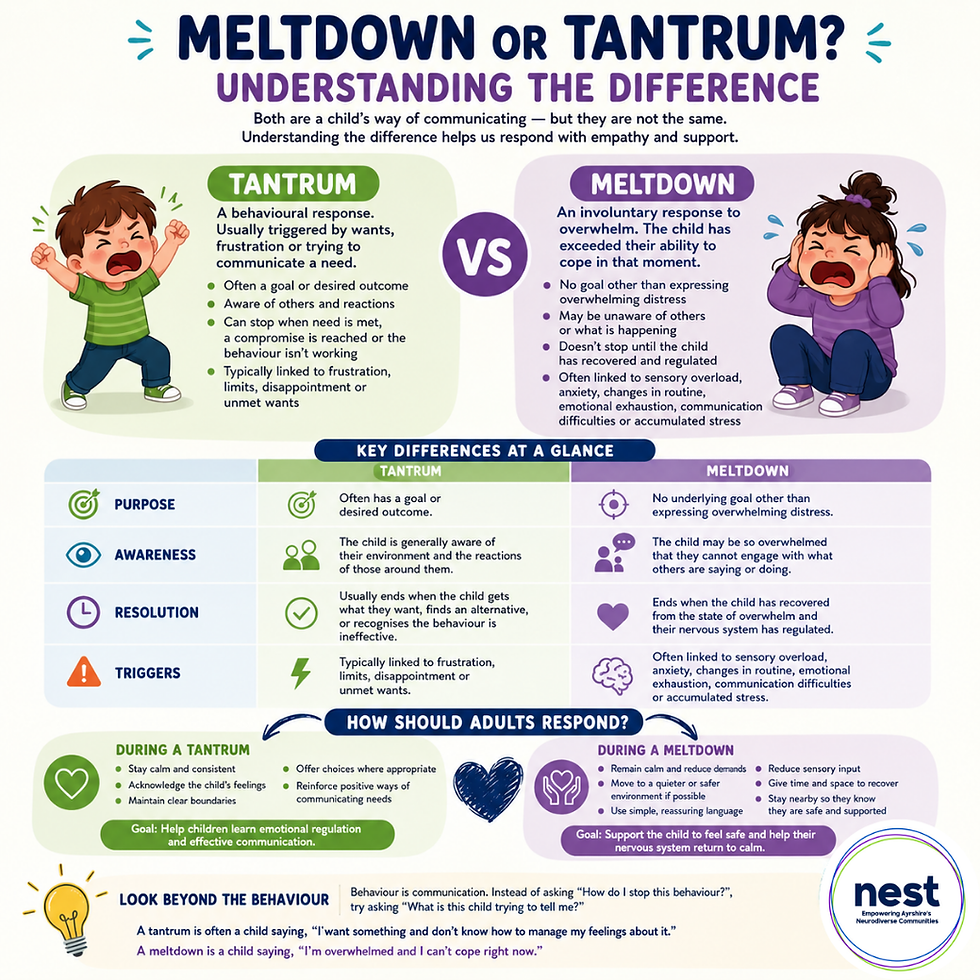
For many neurodivergent individuals, the answer is simple: consequences often address the behaviour we can see, but not the reason behind it.
Understanding why behaviour occurs in the first place is often the key to creating meaningful and lasting change.
Understanding the Difference Between Behaviour and Its Cause 🔎
Behaviour is what we observe.
We see someone refusing a task, becoming distressed, withdrawing, shouting, or struggling to follow instructions.
However, behaviour is rarely the root problem. It is often a response to an underlying challenge such as:
Sensory overload 🤯
Anxiety 😨
Communication difficulties 🗣️
Fatigue
Pain or discomfort 🤒
Burnout 🪫
Unmet needs 🤲
Difficulty understanding expectations 🎯
Emotional dysregulation 😪
If the root cause remains unaddressed, consequences alone are unlikely to change the behaviour for long.
Behaviour Is Communication 🗣️
One of the most important concepts in neurodiversity-affirming practice is recognising that behaviour is a form of communication.
Every behaviour serves a purpose. It may be communicating:
"This environment is overwhelming." 🌪️
"I don't understand what is expected." ❓
"I'm anxious." 😧
"I'm exhausted."
"I need help." 🆘
"I don't feel safe." 🛡️
"This demand is too much for me right now." 📋
When we focus only on consequences, we risk missing the message behind the behaviour.
Consequences Don't Teach Missing Skills 👩🏫
Imagine expecting someone to ride a bicycle without ever teaching them how.
If they fall repeatedly, a consequence will not suddenly give them the skills needed to succeed.
The same principle applies to behaviour.
Many behaviours occur because an individual lacks the skills needed in that moment, such as:
Emotional regulation 😌
Flexible thinking🔄️
Communication skills 💬
Problem-solving skills 🧩
Coping strategies 🛠️
Self-advocacy skills 🗣️
A consequence cannot teach a skill that has not yet been learned.
If someone genuinely does not have the tools to manage a situation successfully, support and teaching are likely to be far more effective than punishment.
Stress Reduces a Person's Ability to Cope 😟
When people are stressed, overwhelmed, anxious, or dysregulated, the parts of the brain responsible for reasoning, decision-making, and self-control become harder to access.
In these moments, behaviour is often driven by survival responses rather than conscious choices.
For example:
A child experiencing sensory overload may lash out.
An overwhelmed teenager may shut down completely.
An exhausted adult may become highly emotional or reactive.
Adding consequences during these moments can increase stress rather than reduce it.
When stress levels rise, behaviour often becomes more difficult rather than easier to manage.
The Same Consequence Does Not Affect Everyone Equally ⚖️
Traditional behaviour approaches often assume that everyone responds to consequences in similar ways.
However, neurodivergent individuals may experience situations very differently.
For example:
A missed playtime may feel insignificant to one child but devastating to another.
Public correction may create shame and anxiety rather than learning.
Loss of privileges may not address the actual reason the behaviour occurred.
Without understanding an individual's needs, sensory profile, and emotional experience, consequences may have little impact on future behaviour.
When Consequences Can Be Helpful 👍
This does not mean consequences have no place.
Natural consequences are an important part of learning about the world.
For example:
If you forget an umbrella, you may get wet. ☔
If you don't charge your phone, the battery runs out.🪫
If you leave food out, it may spoil. 🍎
These consequences are directly linked to the action and help build understanding.
Similarly, clear boundaries and reasonable expectations are important for safety, consistency, and learning.
The key difference is that supportive consequences are paired with understanding, skill-building, and problem-solving rather than punishment alone.
When behaviour becomes challenging, it can be helpful to ask:
What Is the Behaviour Communicating? 🤔
Before reacting, pause and consider:
What happened before the behaviour?
Is the person overwhelmed?
Are there unmet needs?
Is something causing distress?
Understanding often leads to more effective solutions.
Reduce Barriers 🚧
If a task is causing repeated difficulties, consider whether adjustments are needed.
Examples might include:
Breaking tasks into smaller steps 🤏
Providing visual supports 👀
Reducing sensory demands 🎧
Offering additional processing time ⏱️
Adjusting expectations temporarily 🎯
Teach Skills 👩🏫
If a skill is missing, focus on teaching rather than punishing.
Support may include:
Emotional regulation strategies 😌
Communication tools 💬
Problem-solving techniques 🧩
Coping skills 🛠️
Self-advocacy skills 🗣️
People are more likely to succeed when they have the skills needed to meet expectations.
Strengthen Relationships 💪
Research and experience consistently show that people learn best when they feel safe, respected, and understood.
A strong relationship creates opportunities for trust, communication, and collaborative problem-solving.
When individuals feel supported rather than judged, they are often more willing and able to make positive changes.
Moving From "What's Wrong?" to "What's Happened?"
A powerful shift occurs when we stop asking:
"What's wrong with them?"
And start asking:
"What's happened?"
Or:
"What support do they need right now?"
This change in perspective encourages curiosity instead of blame and understanding instead of punishment.
Consequences may sometimes influence behaviour, but they do not always address the reasons behaviour occurs in the first place.
For many neurodivergent individuals, behaviour is often linked to sensory needs, stress, anxiety, communication differences, burnout, unmet needs, or skill gaps.
When we focus solely on consequences, we can miss valuable opportunities to understand and support the person behind the behaviour.
Lasting behavioural change is more likely to happen when we combine clear expectations with empathy, understanding, skill-building, and appropriate support.
Instead of asking, "How can I stop this behaviour?" we might achieve better outcomes by asking, "What is this behaviour trying to tell me?"


Comments