


Myth Busting Neurodiversity: "RSD Isn't Real, You're Just Too Sensitive" 🚫

Few neurodivergent experiences are dismissed as quickly as Rejection Sensitive Dysphoria, often known as RSD.
Many people have heard comments such as:
"You're taking it too personally." 🚫
"You're too sensitive." 🚫
"You need thicker skin." 🚫
"You're overreacting." 🚫
"Everyone gets rejected sometimes." 🚫
While most people experience hurt, disappointment or rejection at some point, RSD is often described as something much more intense.
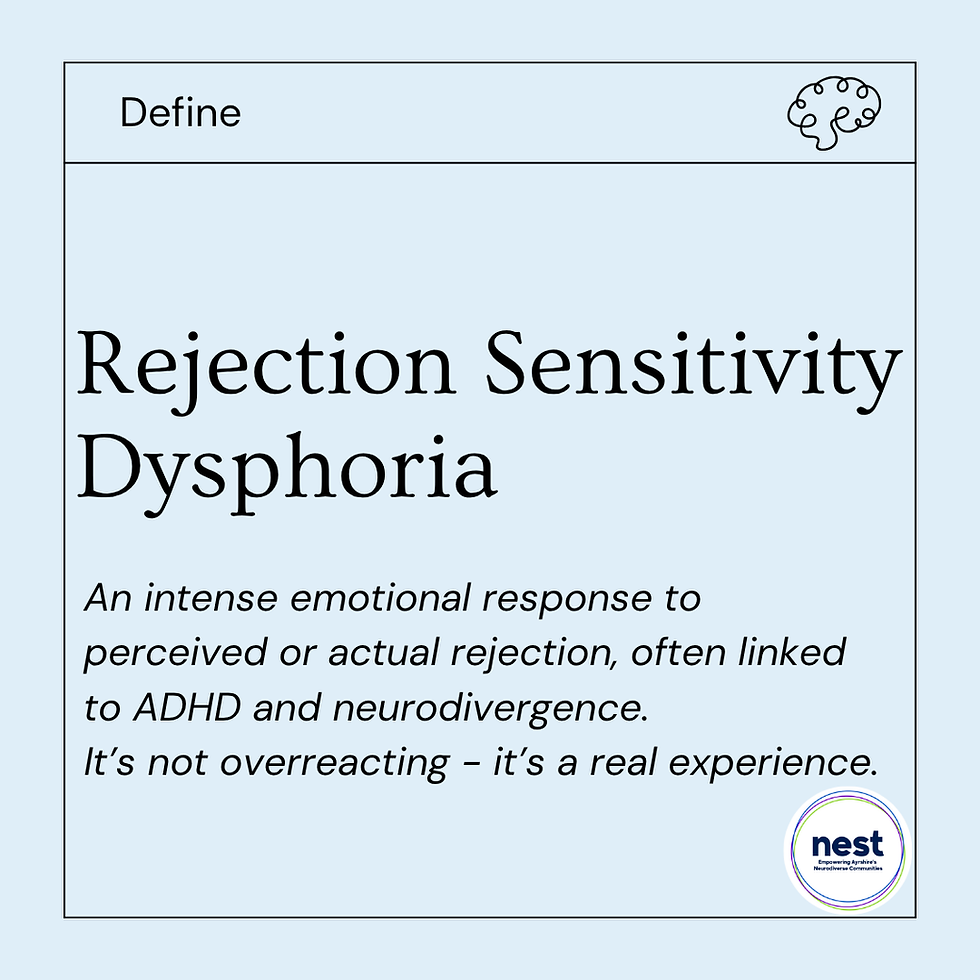
It involves a strong emotional response to real or perceived rejection, criticism, disapproval or failure.
So, let's bust the myth.
The Myth ❌
"RSD isn't real. You're just too sensitive."
The Reality ✅
While Rejection Sensitive Dysphoria is not currently recognised as a standalone diagnosis, it is a term widely used by clinicians, researchers and neurodivergent communities to describe an intense emotional response to rejection, criticism or perceived failure.
Many people with ADHD, autism and other neurodivergent experiences report that rejection can feel overwhelming, painful and difficult to regulate.
The fact that RSD is not a separate diagnosis does not mean the experience is not real. [
What Does RSD Feel Like? 💔
Everybody experiences rejection differently.
For someone experiencing RSD, rejection or criticism may feel:
Intense 💥
Deeply personal ❤️
Difficult to move on from 🔄
Emotionally overwhelming 🌊
Physically painful at times ⚡
This can happen in response to:
Constructive feedback 📝
A disagreement 💬
Being left out of plans 🎉
A change in someone's tone of voice 🗣️
A delayed reply to a message 📱
Making a mistake ⚠️
Feeling like you have disappointed someone 💭
The emotional response is real, even when the rejection is perceived rather than intentional.
It's Not Just About Rejection 🚫
One of the biggest misconceptions about RSD is that it's only about how someone reacts after rejection happens.
In reality, many people spend significant amounts of energy trying to avoid rejection altogether.
This may look like:
People pleasing 🤝
Perfectionism ✨
Avoiding new opportunities 🚪
Over-apologising 💬
Constantly seeking reassurance ❤️
Masking 🎭
Avoiding conflict 🌧️
Replaying conversations repeatedly 💭
What others see as "trying too hard" may actually be an attempt to protect themselves from emotional pain.
Why Might Neurodivergent People Experience RSD? 🧠
There isn't one simple explanation.
Many neurodivergent people grow up experiencing:
Frequent correction 📚
Misunderstandings 💭
Social rejection 💔
Bullying 🚫
Criticism ⚖️
Feeling different from peers 🌈
Over time, these experiences can shape how safe it feels to make mistakes, take risks or be vulnerable.
Research and clinical understanding also suggest that differences in emotional regulation may contribute to why rejection-related emotions can feel more intense for some neurodivergent people.
Being Sensitive Isn't A Weakness 💜
Let's challenge another assumption.
Why is being sensitive treated as something negative?
People who experience RSD are often also:
Empathetic ❤️
Caring 🤝
Loyal 💜
Thoughtful 💭
Passionate 🌟
Strong advocates for fairness ⚖️
The depth of feeling that contributes to rejection sensitivity can also contribute to meaningful relationships and emotional awareness.
The goal isn't to stop caring.
The goal is to develop tools and support that help manage the intensity of difficult emotions.
Supporting Yourself If You Experience RSD 🌱
Recognise the Pattern 🧠
Sometimes simply recognising that RSD might be showing up can help create space between the trigger and the reaction.
Ask yourself:
What actually happened ❓
What evidence do I have 💭
Could there be another explanation 🤔
Pause Before Responding ⏸️
When emotions are high, it can be helpful to delay responding to emails, messages or conflict where possible.
Giving yourself time can reduce regret later.
Challenge the Inner Critic ❤️
Many people with RSD are far harder on themselves than they would ever be on someone else.
Try asking:
Would I say this to a friend 💜
Am I assuming the worst ⚖️
What would a compassionate response sound like 🌱
Build Safe Relationships 🤝
Supportive relationships can make a huge difference.
Being around people who communicate clearly and respectfully can help reduce uncertainty and self-doubt.
Supporting Someone With RSD 🤝
Avoid Dismissing Feelings 🚫
Comments such as:
"You're too sensitive." ❌
"It's not a big deal." ❌
"You're overreacting." ❌
can increase shame and make it harder for somebody to seek support.
Validate The Experience 💜
Validation doesn't mean agreeing that rejection occurred.
It means recognising that the feelings are real.
Try saying:
"I can see this has really affected you." ❤️
"That sounds difficult." 🤝
"Would it help to talk it through?" 💭
Be Clear In Your Communication 💬
Clear, direct communication can reduce uncertainty and minimise misunderstandings.
Myth Busted ✅
RSD is not simply a case of being "too sensitive."
While it is not a formal diagnosis in its own right, the experience of intense emotional pain linked to rejection, criticism or perceived failure is very real for many neurodivergent people.
Dismissing someone as "too sensitive" overlooks the complexity of what they may be experiencing.
Understanding RSD isn't about encouraging people to avoid difficult emotions.
It's about recognising that some people experience those emotions more intensely and may need understanding, support and strategies to help them navigate them.
Because compassion will always get us further than criticism.



Comments