


Sensory‑Friendly Self‑Care: Beyond Bubble Baths

When people talk about self‑care, the advice is often well‑meaning.
“Run a bubble bath.”
“Book a spa day.”
“Light a scented candle and relax.”
For some people, that sounds lovely.
For others - especially neurodivergent people - it can feel frustrating, unrealistic, or even uncomfortable.
Self‑care is not one‑size‑fits‑all. And it certainly is not a trend, a luxury, or a checklist.
For neurodivergent individuals, self‑care is often about safety, regulation, and comfort - not indulgence.
Let’s talk about what sensory‑friendly self‑care really looks like, and how we can move beyond the bubble bath stereotype 🌱
Why traditional self‑care advice doesn’t work for everyone
Many popular self‑care ideas assume that:
Quiet feels calming
Touch feels soothing
Strong scents help people relax
Being still is restful
But sensory experiences are processed differently in neurodivergent brains.
For some people:
Hot water can feel overwhelming or painful
Scents can trigger headaches or nausea
Silence can feel unsettling
“Relaxing” environments can increase anxiety
Someone might leave a spa feeling more dysregulated than when they arrived. And that does not mean they are doing self‑care “wrong”.
👉 The problem is not the person. The problem is the assumption that self‑care looks the same for everyone.
What self‑care really means
At its heart, self‑care is about supporting your nervous system.
That might include:
Reducing sensory overload
Adding helpful sensory input
Finding predictability and control
Creating moments of rest or reset
Self‑care can be:
Preventative
Responsive (after a difficult day)
Small and ordinary
Built into daily routines
It does not need to be Instagram‑worthy.
It needs to work for you 💛
Sensory‑friendly self‑care ideas
Below are practical examples that can be mixed, matched, or adapted to suit different sensory preferences.
For body comfort and grounding 🧘
Wearing snug or familiar clothing
Wrapping up in a favourite blanket
Sitting in a comfortable, supportive chair
Using deep breathing or body‑based calming exercises
These can help the body feel safe and settled.
For sound sensitivity or support 🎶
Noise‑reducing or noise‑cancelling headphones
Gentle background noise (rain sounds, brown noise, fan sounds)
Creating a “quiet corner” at home
Listening to a familiar podcast or audiobook
Silence is not always calming. Familiar sounds can feel regulating.
For movement and regulation 🏃
Stretching between tasks
Rocking, pacing, or swaying
Short walks, especially in nature
Repetitive movement like swimming, cycling, or dancing
Movement is self‑care. Rest does not always mean stillness.
For visual comfort 👁️
Soft lighting or lamps instead of bright overhead lights
Calming colours
Reducing clutter in one small area
Wearing sunglasses indoors if needed
Your eyes need comfort too
For emotional and cognitive comfort 🧠
Listening to a favourite playlist
Rewatching a familiar TV show
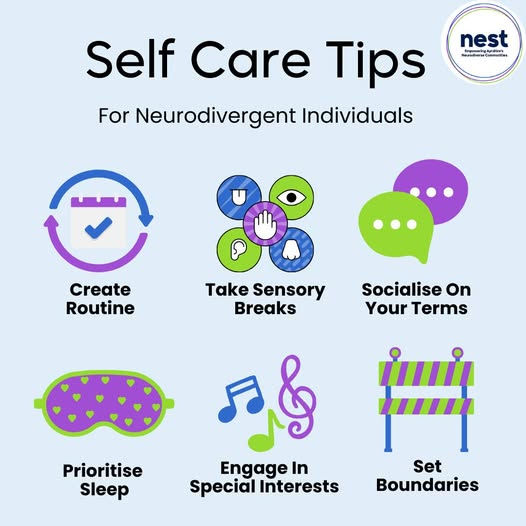
Engaging in special interests
Writing thoughts down to “make space” in your head
Comfort and joy count as self‑care. Always.
Creating a sensory‑friendly space at home 🏡
You don’t need a special room. Even one predictable, safe space can help.
Simple ideas:
Keep a basket with comfort items (headphones, fidgets, soft textures)
Use labels or visual cues to reduce cognitive load
Allow control over lighting and temperature
Build in quiet time after busy parts of the day
Consistency matters more than perfection.
Supporting children and young people
For parents and carers, self‑care is often talked about for children instead of with them.
Helpful approaches include:
Observing what helps your child calm or focus
Offering choices rather than instructions
Avoiding activities that “should” be relaxing
Letting children opt out without shame
Self‑care for children might look like:
Jumping on a trampoline
Sitting under a table with books
Wearing headphones during family meals
Spending time alone after school
These are not “avoidant behaviours”.
They are regulation strategies 🌈
Letting go of pressure and comparison
Self‑care is not:
A reward for coping
Something you earn
Another thing to get “right”
If something helps you feel safer, calmer, or more balanced - even briefly - then it counts.
You are allowed to:
Change what works
Need support
Choose comfort
Honour your nervous system
A gentle reminder 💭
Self‑care is deeply personal.
It is about listening to your body, respecting your sensory needs, and creating moments that support regulation - not chasing trends or ticking boxes.
Whether you’re neurodivergent yourself, supporting a child, or working alongside families and communities, sensory‑friendly self‑care is an act of understanding and empowerment.
And that - and you - are worth it 💚


Comments